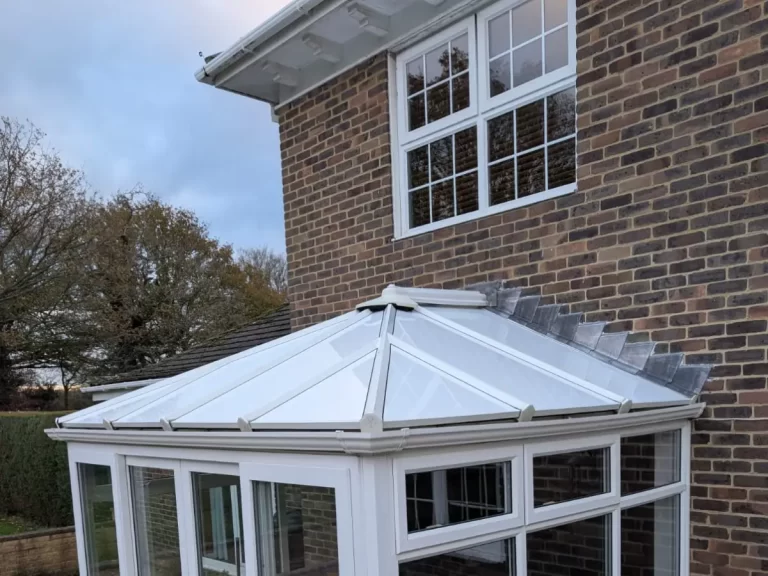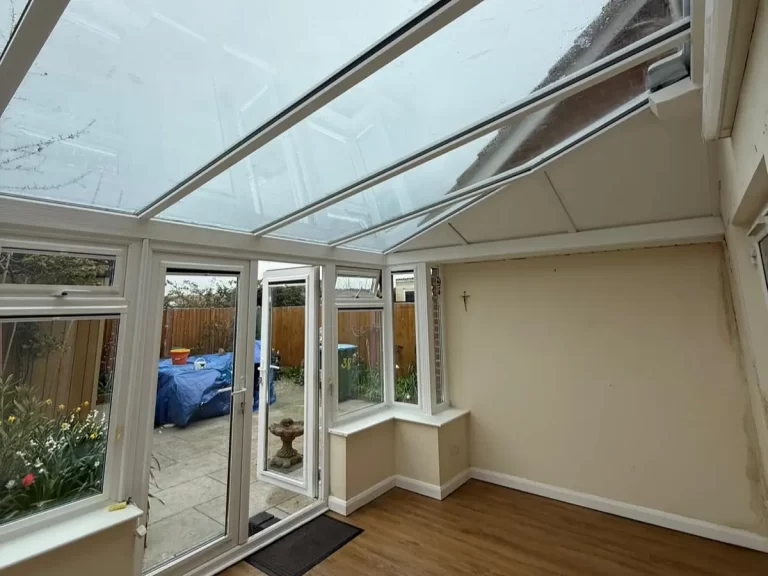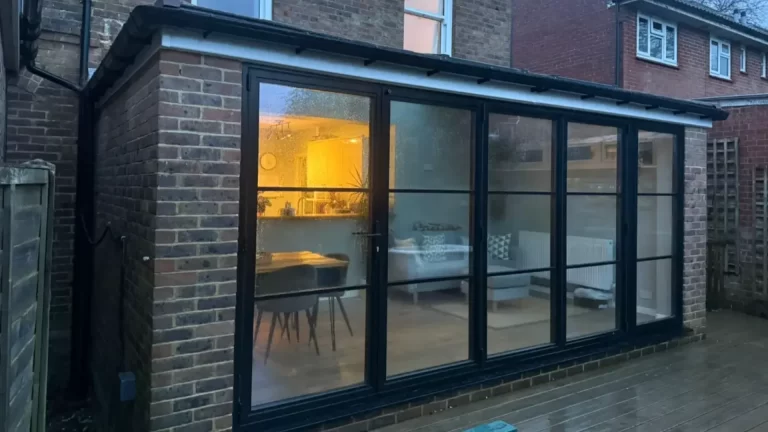



If you’ve ever found your conservatory is too hot in summer and too cold in winter, that’s basically conservatories in a nutshell. The problem ensures they sit empty for much of the year, and the roof is nearly always the culprit.
But the good news is that, compared with traditional glass or polycarbonate, eco-panels for conservatory roofs offer a better balance of thermal performance, lower running costs, and a lower environmental impact. They are not the right choice in every situation, but for most homeowners wanting a more comfortable, usable space, they are the practical middle ground.
Understanding why means looking at what each option delivers across performance, installation, cost, and sustainability, which is what this guide works through.
What Are Eco-Panels and How Do They Compare to Traditional Conservatory Roofing?
The choice of roof type often comes down to polycarbonate, glass, or insulated panel systems. But how do these three stack up?
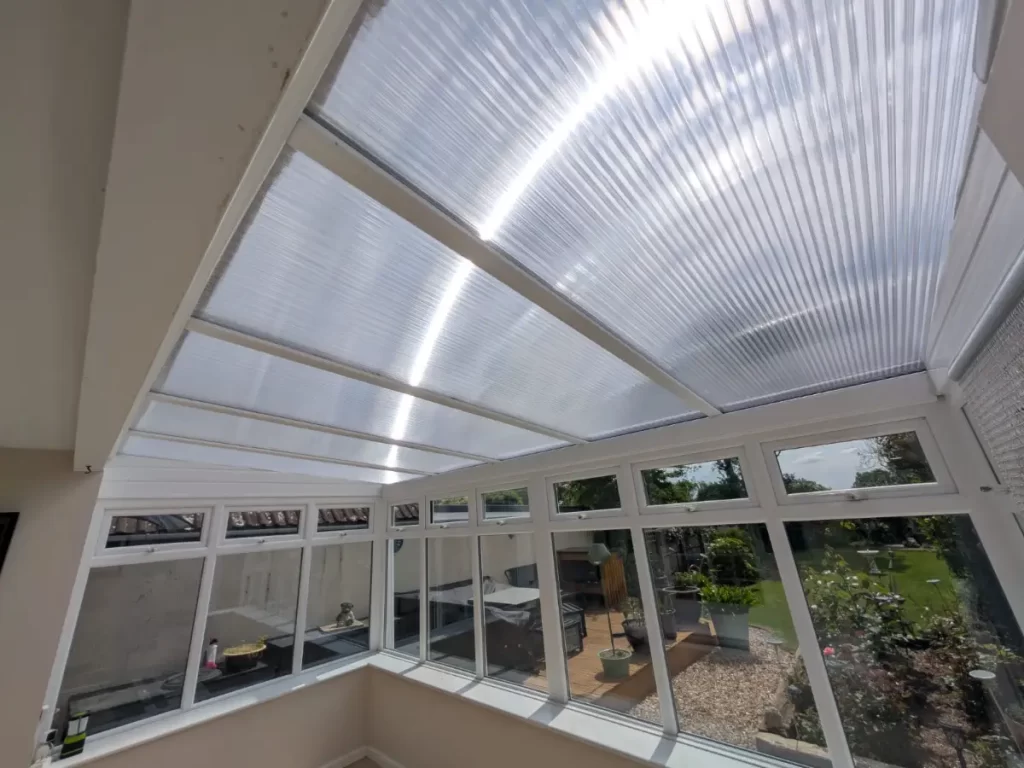
Polycarbonate
The original conservatory roofing material. Lightweight and low in upfront cost, but standard polycarbonate tends to be poor at retaining heat in winter and prone to overheating in summer, with U-values typically in the range of 1.5 to 2.4 W/m²K.
Ecozenic’s Eco-Shield polycarbonate roof is a significant step up from traditional polycarbonate. It achieves U-values as low as 0.83 W/m²K and includes a dual-tint option that reduces solar heat gain by up to 50%, giving homeowners much better year-round comfort while keeping the lightness and character of a polycarbonate system.
Glass
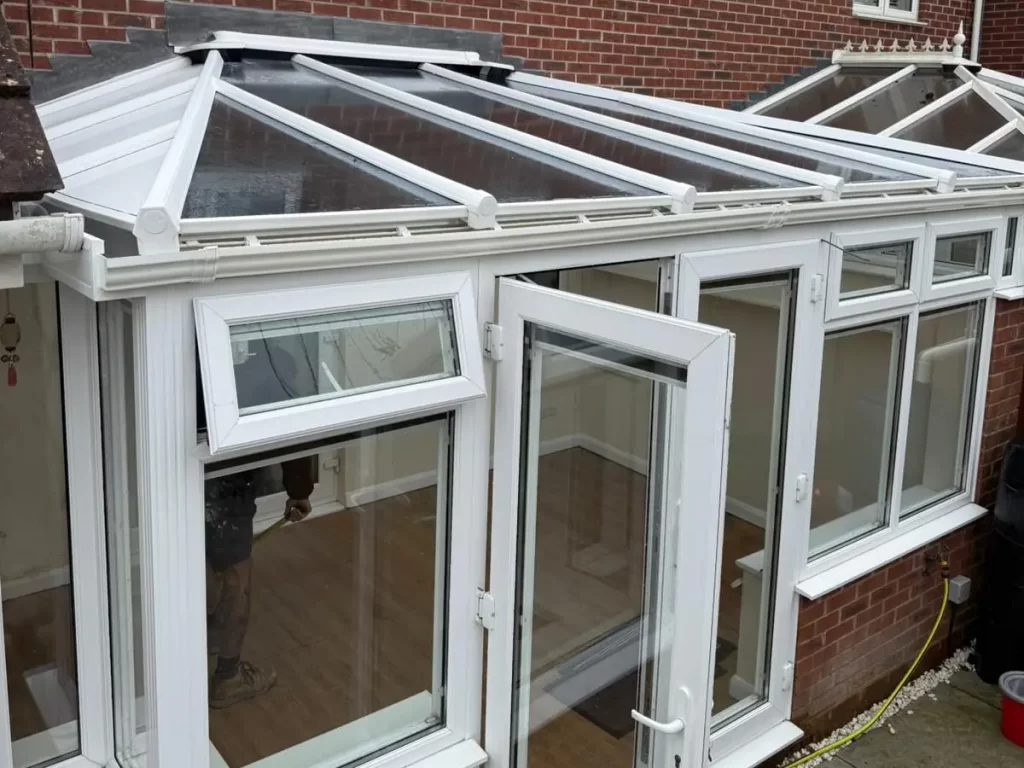
The choice for homeowners who prioritise light and aesthetics above all else. Our glass conservatory roofs are available in a range of architectural styles, frame colours, and glass tints, with thermal efficiency improved further by adding chambered top caps.
They come with a 10-year manufacturing warranty and are made in Britain. Older or budget glass roofs can still underperform thermally, but a well-specified glass roof from Ecozenic is a meaningfully different proposition to the standard double-glazed options that gave glass a poor reputation for heat retention.

Eco-Panels for Conservatory Roofs
Insulated conservatory roof panels that replace existing roof elements entirely. Our Eco-Panels are manufactured with a ravatherm XPS extruded polystyrene core, encased in polyester powder-coated aluminium on both sides, giving a durable, non-glare finish that requires no maintenance.
Two thicknesses are available: 24mm with a U-value of 1.13 W/m²K and 28mm with a U-value of 0.98 W/m²K. Panels are self-cleaning, UV-resistant, and supplied in a range of RAL colours to match any conservatory frame. Unlike a tiled or solid roof, they retain diffused natural light, making them a practical option for sustainable conservatory roofing without closing the room off from the outside.
Energy Efficiency and Thermal Performance: Which Roof Actually Keeps the Heat In?
The Energy Saving Trust confirms that homes can lose around 25% of their heat through an uninsulated roof [1]. In a conservatory, where the entire ceiling is essentially a roof, that figure becomes even more significant.
Standard polycarbonate carries U-values of 1.5 to 2.4 W/m²K. Older glass roofs perform similarly. Both lose heat rapidly in winter and absorb solar gain in summer, which is why so many conservatories become unusable at the temperature extremes.
Ecozenic’s insulated conservatory roof panels achieve U-values of 1.13 W/m²K at 24mm and 0.98 W/m²K at 28mm, with the Eco-Shield polycarbonate option reaching 0.83 W/m²K. All are a meaningful step up on standard materials.
Solid or tiled roofs outperform in U-values, with figures around 0.15 to 0.18 W/m²K, but remove most natural light. For homeowners who want energy-efficient roof panels without losing that, the panel system occupies exactly the right position.
The Environmental Case for Eco-Panels
Heating accounts for almost 20% of total UK carbon emissions, according to the Climate Change Committee [2]. Any improvement that reduces the work a heating system has to do in a conservatory lowers that figure at a household level.
Eco-panels for conservatory roofs reduce operational carbon in two ways: by reducing heat loss in winter, which lowers boiler demand, and by limiting solar gain in summer, which lowers cooling demand. The cumulative reduction in energy consumption over the lifespan of an installation is meaningful.
There is also a materials case for retrofitting within the existing roof frame, as it generates considerably less demolition waste and embodied carbon than a full tear-off and rebuild. Ecozenic’s recycling scheme ensures old roofing materials are removed and recycled rather than going to landfill. Recyclable roofing materials and responsible disposal are part of what make eco-friendly home improvements worth assessing beyond U-values alone.
Installation, Maintenance, and Durability
One of the practical advantages of insulated conservatory roof panels is the speed of installation. A typical installation is completed in a single day, with minimal disruption to the household. A full solid or tiled roof conversion involves considerably more preparation, structural work, and time on site, which directly affects both cost and inconvenience.
Key practical advantages of Eco-Panel installation include:
- Single-day installation in most cases, meaning no extended disruption to your home.
- No requirement to vacate the property during the work.
- Fits any conservatory roof shape, without the structural modifications sometimes needed for solid roof systems.
- Low ongoing maintenance, with no specialist cleaning or treatments required.
- Durability over 10 or more years, backed by Ecozenic’s IWA Insurance-Backed Guarantee
Traditional polycarbonate panels tend to yellow and become brittle over time and are more susceptible to impact damage. Glass roofs are more durable but require regular cleaning to prevent algae build-up, and any cracking or seal failure can be costly to address.
Energy-efficient roof panels, when correctly installed, sit between these two in terms of maintenance burden and comfortably ahead of polycarbonate in terms of lifespan. Recyclable roofing materials are also considered at the end of life, as we remove and recycle old roofing materials during installation.
The True Cost Comparison: Upfront Investment vs Long-Term Value
Upfront costs vary with size, shape, and specification, so any figures here are indicative. As a broad reference, polycarbonate replacements currently range from £400 to £800 per square metre, glass from £600 to £1,200, and solid or tiled systems from £600 to £900. Insulated panel systems sit above a basic polycarbonate job but below the upper end of tiled conversions.
The upfront figure is only part of the picture for any green building conservatory upgrade. Eco-panels for conservatory roofs reduce heating demand year-round, so energy bills fall from the point of installation. Over a ten-year window, those savings narrow the effective price gap considerably. Traditional polycarbonate also tends to need replacing sooner, which adds further costs over time.
Ecozenic offers 0% finance, meaning the installation cost can be spread without interest, making it easier to choose the option that delivers genuine long-term value.

Are Eco-Panels the Right Choice for Your Conservatory?
The honest answer is that it depends on what you are trying to achieve. Eco-panels for conservatory roofs are not the best option in every scenario, and it is worth being clear about that.
If keeping upfront costs to an absolute minimum is the only priority, basic polycarbonate remains the cheapest entry point, though you will accept the performance limitations that come with it. If maximising natural light and aesthetics are your main goals, a high-quality glass roof may suit you better. If thermal performance is the overriding priority and natural light is not a concern, a solid or tiled roof system will outperform a panel retrofit on U-values alone.
For most homeowners, however, the priorities sit somewhere across all three: a room that is comfortable year-round, lower heating bills, a faster and less disruptive installation, and a solution that does not eliminate the light that makes a conservatory worth having.
That is where Eco-Panels consistently perform well. They represent a considered upgrade rather than a compromise, and for most conservatories across Dorset, Hampshire, Wiltshire, and the wider South of England, they are the option that delivers the greatest usable improvement for the investment.
Find Out What the Right Roof Looks Like for Your Conservatory
In short, every conservatory is different, and the right roofing solution depends on how you use the space, your budget, and what you want the room to feel like once the work is done.
If you would like straightforward advice on whether Eco-Panels are suited to your conservatory, get in touch with our team. Call us on 01202 798666 or fill in our contact form, and we will talk you through the options with no obligation.
External Sources
[1] Energy Saving Trust, “The Energy Saving Trust confirms that homes can lose around 25% of their heat through an uninsulated roof”: https://energysavingtrust.org.uk/advice/roof-and-loft-insulation/
[2] Energy UK, “Heating accounts for almost 20% of total UK carbon emissions, according to the Climate Change Committee”: https://www.energy-uk.org.uk/insights/decarbonising-heat-and-transport/